

Part I of a three-part series investigating the challenges facing the UK’s fleet of nuclear-powered, conventionally-armed submarines (SSNs), or Attack Submarines. This section focuses on extended construction and delays of the current Astute-class SSNs at Barrow-in-Furness, Cumbria. It covers the reasons and impacts of these delays; beyond their ability to provide essential support to the nuclear-powered, nuclear-armed fleet, or Ballistic Missile Submarines (SSBNs). It then concludes by analysing the government’s plans to construct the future AUKUS SSNs.
Background Context
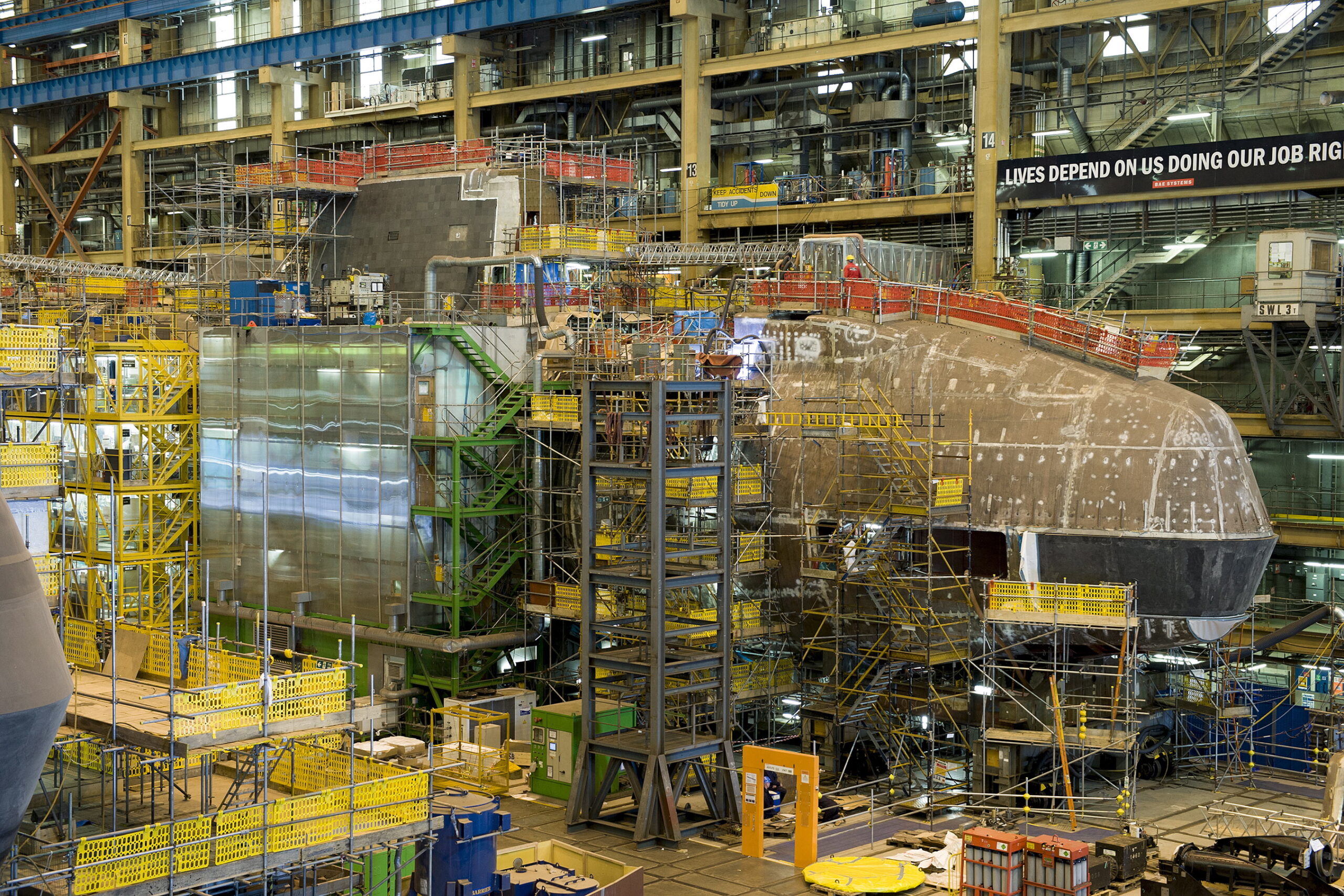
The contract to replace the preceding Swiftsure and Trafalgar class SSNs with the Astute-class SSNs was signed in 1997. The design and construction of the UK’s submarines takes place at the Barrow shipyard, the main building site for submarines. Each submarine is comprised of separate modules, and these are built in different areas across the shipyard prior to being assembled in the Devonshire Dock Hall. BAE Systems is the main contractor for the submarines, bearing primary responsibility for their build, test, and commissioning, and owns and operates the Barrow shipyard. The contract initially covered three boats, with seven being the ultimate figure settled by the Ministry of Defence (MOD).
At first glance, it may seem that the number of submarines built, and the pace at which they are built, matters little if those submarines cannot be deployed to sea because they are awaiting repairs or maintenance (issues to be discussed in more detail in Part II); especially since this is how various media outlets have prominently framed the SSN availability problem. But these background conditions can impact the future availability of submarines. As advised in a 2011 Major Projects Report by the National Audit Office (NAO), which scrutinises government spending, the MOD’s availability requirement would have been easier to meet with eight submarines. Hence the report warned that reducing the planned fleet from eight boats to seven (phrased as an MOD requirement of “up to eight” boats), alongside a decision to slow down the pace of Astute boat construction, risked leaving the Royal Navy without sufficient submarines to execute the MOD’s tasks.
The following sections examines the pace of Astute-boat construction, including the inconsistencies and methodological difficulties in making such calculations. It then considers the reasons for the extended delivery timelines of the Astute programme, from technical and industrial challenges to this deliberate decision to construct Astute submarines at a slower pace, before outlining the impacts of these delays beyond exacerbating the SSN availability crisis. Finally, an assessment will be given of future plans for SSN construction and prospects for the SSN-AUKUS programme, the trilateral defence partnership between the UK, US, and Australia to deliver future attack submarines and advanced military technology.
Submarine Building Timescales
Table 1. Milestones of the Astute-class submarines
| Astute Boat | Steel Cut | Keel Laid | Commissioning | Departure for Sea Trials | Operational Handover to Royal Navy |
| HMS Astute | October 1999 | January 2001 | August 2010 | November 2009 | April 2013 |
| HMS Ambush | Not specified | October 2003 | March 2013 | September 2012 | June 2013 |
| HMS Artful | 2005 (Month not specified) | March 2005 | March 2016 | August 2015 | December 2015 |
| HMS Audacious | 2007 (Month not specified) | March 2009 | April 2020 | April 2020 | September 2021* |
| HMS Anson | 2010 (Month not specified) | October 2011 | August 2022 | February 2023 | May 2024*** |
| HMS Agamemnon | July 2013** | July 2013 | September 2025 | September 2026 | Pending |
| HMS Achilles | January 2014 | May 2018 | Pending | Pending | Pending |
Steel cutting – The beginning of physical construction of a submarine. Keel laying – A formal ceremony ‘symbolically’ marking the beginning of construction of a submarine. Commissioning – A ceremonial occasion in which the boat formally joins the Royal Navy fleet. Departure for Sea Trials – When the submarine leaves Barrow for sea trials, such as crew training and weapons demonstrations. Operational Handover – The official transfer of the submarine from the contractor to Royal Navy command.
*According to a parliamentary response in late April 2020, HMS Audacious was commissioned into the Royal Navy on 3 April 2020, one day before it reportedly departed Barrow for sea trials. But a second formal commissioning ceremony was held in September 2021 to mark its completion of sea trials, readiness for global operations and entry into the Royal Navy.
**In contrast to the other Astute boats, one outlet describes the steel for the sixth boat, HMS Agamemnon, as being cut on the same month as its keel was laid.
***The exact operational handover date for HMS Anson is not provided. Hence this is preliminarily estimated based on the month in which the boat concluded its sea trials.
Measuring Submarine Build Times
One issue when assessing the construction timetable of a submarine is how to calculate the length of time that the boats are built. According to a 2016 parliamentary response from the then-Minister of State for the MOD, Earl Howe, submarine build time is “measured between the start of manufacture and operational handover to the Royal Navy”. The response also added that “keel laying and commissioning have no bearing on the build programme. These are ceremonial milestones only: commissioning can happen before or after operational handover”. This qualification appears in the table above: HMS Astute was handed over to the Royal Navy after commissioning, and HMS Artful was handed over before commissioning. As for the keel, widely understood as the submarine’s backbone, historically, the first submarines were built from the keel upwards, but this is no longer the case in contemporary submarine construction, particularly with the advent of the modular-build approach. Due to these changes, the Royal Navy regards keel-laying as a largely symbolic milestone in submarine construction. Hence steel-cutting, not keel laying, is understood in this analysis as marking the start of manufacture.
The first in the class, HMS Astute, was initially supposed to be constructed and delivered in 100 months, or June 2005, but the submarine faced recurring delays. Despite this, officials assured that such prolonged build periods were to be expected with the first of a new class of submarine, and that the delivery rate of the following Astute boats would thus improve as lessons were learned. In response to a parliamentary question inquiring into the consequences of submarine availability falling short of the Department’s requirement between 2015 and 2021, as warned by the NAO, MP Quentin Davies, the Parliamentary Under-Secretary of State and Minister for Defence Equipment and Support, responded that “the first of class has problems – there always will be unanticipated difficulties because you have never built that particular type before – and then the second of class, the third of class becomes easier and cheaper, less delays, and so on and so forth”.
Based on parliamentary testimony using the measure of submarine timescales from start of manufacture to operational handover, a successive reduction in build times was observed for the first three submarines at 170 – 149 – and 137 months. However, these figures seem to differ from the measurements in Table 1. For example, according to that table, and measuring from steel cutting to operational handover, HMS Astute took 162 months, not 170 (measured from steel cutting to operational handover, the estimated construction times for boats four and five are 172 and 170 months respectively. A later section will explain how the steel-cutting dates for these and other Astute boats were tentatively estimated).
This discrepancy alludes to the broader problem of how vague and/or inconsistent the reported construction timescales for Astute-class submarines can be. For example, HMS Ambush has been described as taking BAE Systems nearly twelve years to build in one outlet and over nine years in another. Additionally, the submarine build times for the Astute-class SSNs calculated by some outlets appear highly consistent with measuring from keel-laying to commissioning. The following section suggests alternative ways of measuring construction times, as well as their respective benefits and limitations. Such limitations include not only vague reporting but also non-reporting of certain milestones.
Measuring Timescales at Barrow
Submarine construction timescales can be measured from steel cutting to departure for sea trials, rather than to operational handover. Since the former period encompasses the beginning and end of work undertaken at Barrow, it can be a helpful measure of the shipyard’s capacity to manufacture and deliver submarines. (Also, just as a boat can be commissioned before or after operational handover, so can it be commissioned before or after it departs for sea trials, as illustrated in Table 1.) Nevertheless, even this approach yields uncertainties and ambiguities, which reflects the lack of complete transparency in the Astute programme, as will be explained in the next section.
Limitations
The precise steel-cutting dates for most of the Astute boats are not specified. Following from this, their build times will be assessed using informed estimates, while stating the relevant limitations and background assumptions that need to be taken into account. These should therefore not be regarded as the confirmed steel-cutting dates, but tentative estimates. Starting with HMS Artful, this boat’s departure for sea trials on August 2015 was reported by various outlets to have been almost ten and a half years since first steel was cut on the boat. As with HMS Agamemnon, for which the steel-cutting month reportedly coincided with its keel-laying month, this means that it is possible that Artful’s steel was also first cut on its keel-laying month, which was March 2005. Accordingly, March 2005 is preliminarily estimated as the steel-cutting month for Artful. For HMS Audacious, various sources indicate that its steel was cut in 2007, while one states that construction started in May 2007. Due to this, May 2007 will be used as a provisional date, though limited by the fact that the source does not explicitly link “beginning of construction” to steel-cutting.
A similar ambiguity surrounds HMS Anson’s build time, which is reported to have been under construction in Barrow since 2010, but without a specific steel-cutting month attached. Although, the order for the submarine is known to have been awarded in March 2010. Therefore, March 2010 is provisionally estimated as the steel-cutting date. On the other hand, HMS Ambush’s steel-cutting date was the most difficult to ascertain i.e. there is little evidence of when construction began apart from its keel-laying date. Due to this, Ambush will be excluded from the results (remarkably, the steel-cutting dates for every Dreadnought SSBN are publicly available, yet the same level of disclosure is lacking for most of the Astute-class SSNs). Finally, since the final boat, HMS Achilles, remains in Barrow and has yet to depart for sea trials, it will not be included in the results below.
Results
Table 2. Estimated timescales from steel cutting to departure for sea trials
| Astute Boat | Steel Cutting to Departure for Sea Trials |
| HMS Astute | 121 Months |
| HMS Artful | 125 Months |
| HMS Audacious | 155 Months |
| HMS Anson | 155 Months |
| HMS Agamemnon | 158 Months |
As shown in Table 2, according to the measurement of steel cutting to sea trials, the limited public data does not point to a consistent, progressive reduction in build times, but an increase. In addition, despite earlier parliamentary claims of successive reductions in the build times of the first three boats, BAE Systems stated in 2021, following the delayed delivery of the fourth boat, HMS Audacious, that the delivery of an Astute submarine “every three years or so” was not in line with the contract (the company however did not specify which milestones were used to generate this interval). Resolving the delayed delivery of Audacious also required staff working on the fifth boat, HMS Anson, to be redirected to work on Audacious. Despite parliamentary acknowledgement that this delay to HMS Audacious would impact the delivery of Anson, the latter was touted by the government as having the shortest agreed build schedule of any Astute-class submarine, with a target delivery of nine months ahead of HMS Artful. But according to the above measure, Anson took 155 months, which is 30 months longer than the 125-month figure calculated for Artful.
According to Table 2, the sixth boat, HMS Agamemnon, has taken the longest time to build. Markedly, Agamemnon’s build time technically remains incomplete according to the MOD’s preferred standard of measurement of start of manufacture to operational handover, as this entails that its construction period only ends once it has been operationally handed over to the Royal Navy, which is yet to occur. Also, BAE Systems projected that the three remaining submarines would be delivered by the end of 2026, yet HMS Agamemnon’s only recently departed for sea trials while the final vessel, HMS Achilles, remains in Barrow under construction. Furthermore, Achilles will “inevitably” experience delays after the fire at the Devonshire Dock Hall in late 2024, as was acknowledged earlier this year by the Submarine Delivery Agency (SDA), the body responsible for the procurement and maintenance of the Royal Navy’s submarine fleet.
But reasons for delays extend beyond disruptive incidents such as the Barrow fire in 2024. For example, some of these can be traced to growing pains from novel developments in the Astute programme, such as the first of design authority being the responsibility of industry, and the first-time use of 3D assisted software in the design process. Other reasons however point to more deep-seated issues in the submarine building base, some of which will be described in the next section.
Reasons for, and Impacts of Delays
Cannibalisations
Astute SSNs were singled out in a 2017 National Audit Office (NAO) report as experiencing the highest average amount of “cannibalisations” across ships and submarines in the Royal Navy. The report defines cannibalisation as “removing a working part from one piece of equipment, such as a ship or submarine, to put it into another that is in greater operational need”. One issue not mirroring but bearing slight similarity to this concerns HMS Audacious’s delayed entry into sea trials, which was due to the need for repairs including the replacement of a faulty component with one intended for another Astute-class submarine, as previously described by NIS.
The NAO report found that cannibalisation from submarines in production had increased by 43% over the preceding five years, while the rate within the Astute SSN fleet was described as equivalent to “a part being removed or installed once every two days”. Following contractor action, this issue delayed HMS Artful’s production schedule by 42 days and saddled the MOD with an additional £4.9 million in indirect costs. Additional price increases up to £40 million in the programme were also attributed to cannibalisation, with these increases linked to potential delays of five months for HMS Anson and 10 months for the seventh Astute boat, HMS Achilles, but “reduced to three months given existing contractor poor performance”. As also reported, the MOD does not routinely monitor cannibalisation and its costs across the Navy, but it assesses the extent of this activity for individual vessel types.
Construction Gaps and Decelerating SSN Construction
In a 2015 parliamentary session, the then-Parliamentary Under-Secretary of State at the MOD, Lord Astor of Hever, linked the lengthening submarine construction timescales of the Astute boats to the 10-year gap between delivery of the final Vanguard-class SSBN and the Astute-class programme (the parliamentary question that elicited this response concerned the lengthening of Astute boat construction timescales, but when measured from keel-laying to sea trials, thus again illustrating the variation of how these timescales are measured).
This oft-cited explanation for the sluggish pace of submarine construction attributes the problem to this gap eroding key skills and competencies within the UK’s submarine industrial base. Then again, whereas this gap in construction contributed to the delays in the Astute programme, efforts to close a future gap in submarine construction also prolonged the Astute programme. As explained in the NAO 2011 report, a decision was made in the 2010 Strategic Defence and Security Review to slow down the build of the Astute submarines. This followed decisions taken from 2009 and onwards to slow manufacture of boats two to four and defer the construction of boats five to seven. These extensions were driven by efforts to not only reduce short-term costs and balance the MOD budget, but to also sustain submarine construction and hence avoid a gap caused by a four-year delay to introducing the Successor (now Dreadnought) SSBN programme. This outcome was anticipated by a 2005 RAND Institute study, which cautioned that failing to seamlessly proceed to a Successor programme may compel building the Astute boats at a slower pace.
Beyond culminating in a billion increase in costs to complete the programme, this decision led to an average 28 month delay of each submarine in the past three years. The NAO report also argued that this extension would not only raise costs, but also necessitate older boats to remain in service beyond their planned out-of-service dates, reduce scheduled submarine activity, and burden the smaller fleet with a larger workload. One example of these consequences being realised was the extension of some of the preceding Trafalgar-class SSNs’ service lives to compensate for delays to Astute (similar to the extension of Vanguard-class SSBNs’ service lives to compensate for delays to the Dreadnought programme).
The case of the life-extended Trafalgar-class SSNs also illustrate how Astute delays not only undermined the MOD’s availability requirements but may have also led it to compromise public and sailor safety due to its perceived imperative to maintain an attack submarine presence. A 2013 report by the Defence Nuclear Safety Regulator, the MOD’s nuclear safety watchdog, revealed that the ageing, life-extended Trafalgar-class fleet was experiencing a growing number of technical issues. Although the report did not specify their nature, a Guardian media report linked these issues to the ageing nuclear reactors, connected to risks such as cracks and radiation leaks.
Design challenges
According to parliamentary comments by then-Defence Under Secretary Dr Lewis Moonie in 2002, the first Astute-class submarines were delayed due to an extended period spent by BAE Systems in the design and production phases of the programme. One issue raised elsewhere was submarine construction apparently beginning before the design was fully mature, which led to expensive changes that contributed to delays and cost overruns. Part II of this series will describe possible consequences of this for the maintenance and availability of the submarines (thus additionally illustrating how choices and actions taken during the design/construction phase can affect the future availability of submarines).
Future plans
Expanding and Accelerating SSN Construction
The 2025 Strategic Defence Review (SDR) announced plans to construct “up to twelve” new SSNs of the succeeding AUKUS-class. But speculation abounds as to what the actual construction figure will be due to the ambiguous phrasing of “up to”. The government announced that steel for the first SSN-AUKUS will be cut next year in 2027 (various official sources previously indicated that construction would begin by 2030 or the early 2030s). Still, and shortly after this statement, the government also announced it would be deferring the decision as to how much SSNs will be procured under the AUKUS programme to 2028.
Later comments by Luke Pollard, Minister of State at the MOD, emphasized that the delivery of this future SSN fleet, and ambition to procure up to twelve SSNs, depends on improving productivity at Barrow. In July 2026, the government announced a 40% increase in productivity in the shipyard over the last three years (though there is scant publicly available documentation of how this figure was arrived at). The current construction tempo set out in the 2025 SDR, and repeated in the current year 2026, is “to produce a submarine every 18 months”. Pollard additionally stated that the Defence Investment Plan, published in June 2026, provided the necessary investments to achieve this industrial capacity from the mid-2030s. However, assuming this target refers to accelerating the delivery rate previously acknowledged by BAE Systems – roughly one Astute SSN “every three years or so” – to 18 months, then this is a highly ambitious objective to effectively halve the time interval between submarine deliveries and double the rate of SSN production.
Furthermore, as the previous sections have illustrated, there is a lack of consistency and transparency in how the construction periods of attack submarines are measured and reported. This makes it more difficult to independently verify the pace and duration of SSN construction in Barrow. Therefore, more consistency and transparency in the publication of construction milestones would not only strengthen comparative analysis of the build times of successive SSNs, but would also allow claims of progress to be scrutinised on a stronger evidential basis, which would make it easier to assess performance and hold the government and industry accountable for the SSN programme. Strengthening such accountability is all the more vital given the vast sums that have been invested in the SSN programme – and the associated infrastructure upgrades – to ensure its successful delivery, including at taxpayer expense. (NIS will provide updates if greater clarity on these timelines becomes available).
Still, as demonstrated above, past experience, in addition to this limited transparency, implies that the ambition to accelerate future SSN production ought to be met with scepticism, especially given the failure to deliver on previous commitments to reduce construction times, as reflected in the available data. Additional scepticism is warranted by the potential for future SSN construction to clash with the construction of future SSBNs, as the next section will explain.
SSN and SSBN Construction Overlap
Unlike the previous period in which there was a gap between the construction of the Vanguard and Astute-class of nuclear submarines – which reportedly contributed to difficulties in delivering the Astute-class programme on time – the Dreadnought SSBN programme is now anticipated to overlap with the SSN-AUKUS programme, specifically in the early years of the latter, as the Dreadnought SSBNs remain under construction. As noted in oral evidence to the International Relations and Defence Committee in June 2026, increasing capacity at Barrow is fundamental to enabling this overlap.
However, contrary to reducing build challenges, this overlap can introduce a different set of construction problems. The first Dreadnought-class submarine is due to enter service in the early 2030s, with the first SSN-AUKUS submarine scheduled for delivery to the Royal Navy in the late 2030s. However, due to the need for Dreadnought to be completed first, it is highly uncertain if all four Dreadnought-class submarines can be delivered within the 2030s, especially with the delays similarly besetting the Dreadnought programme (October 6 2026 marked a decade since steel was first cut on the first Dreadnought SSBN, which has yet to depart Barrow for sea trials). Any delays to Dreadnought could consequently affect the SSN-AUKUS programme, and hence push back the construction and delivery timelines of the latter. Further highlighting the risks facing both programmes as they overlap, the Defence Committee in April 2026 expressed concern that planned facilities in Australia may, to some degree, siphon the skilled workforce needed at the UK’s submarine-building sites in Barrow and Plymouth. At the same time, it called for greater workforce mobility between UK and Australia in service of AUKUS. The Committee therefore recommended facilitating such workforce mobility while ensuring that it does not undermine workforce retention in the UK.
Design Maturity
As previously mentioned, one risk of proceeding with construction is the design not being matured to a point that minimises the prospect of having to perform costly future reworks to the submarines, which was allegedly one of the issues affecting the first Astute-class submarines. Previous reports in 2024 indicated that the AUKUS design was 70% complete and due to be finalised “in the next year or two”, but there have been no recent updates on the maturity of the AUKUS designs. The Preliminary Design Review for AUKUS was meant to be complete by September 2026, but this remains outstanding. Additionally, the concern with design immaturity is a recurring issue in nuclear infrastructure beyond the submarine programme. A 2020 National Audit Office (NAO) report examining three MOD nuclear infrastructure upgrade projects found that the MOD continued to encounter the same set of challenges to those experienced during previous cycles of investment in nuclear-regulated sites in the 1980s and 1990s. Among these was the tendency to begin construction before requirements and designs were sufficiently matured.
As will be shown in Part II of this series, the issues confronting AUKUS go beyond construction as they also depend on the successful and timely delivery of the upgrade projects at the facilities hosting dry docks for submarine maintenance.